How to define Project Objectives the right way

Every project begins the same way — with an idea and a little excitement. Maybe it’s something you want to fix, improve, build, or finally get off the ground. But very quickly you realize that before you can plan anything, you need clarity on what you actually want to achieve.
This article helps you slow down for a moment, think things through, and put your objectives into words in a way that feels clear, doable, and aligned with the people involved — including you.
Did You Know? The Hidden Truth Behind Project Failure
Did you know that around 80% of projects do not have goals or objectives defined in a way that protects profit and resources?
Have you ever considered that any project you start is defined by just three constraints: Result, Money, and Time?
Did you know that the number one reason for project failure is often found in the goal-setting process? Maybe you’ve experienced one or more of these:
The goals are not clear enough.
The client changes the scope during the project and you run out of budget.
You “get the project on the fly” and make assumptions about the list of goals or SMART objectives.
You feel attacked or blocked by financing and other experts instead of supported.
If any of this sounds familiar, you’re not alone — and it’s not a personal failure.
It’s a definition problem, not a discipline problem.
Why Project Objectives Matter More Than Planning
Most projects don’t fail in execution — they fail in definition.
The goals sound right, the kickoff is enthusiastic, but weeks later the team drifts off course.
Budgets stretch, clients change direction, and everyone wonders what “success” was supposed to look like in the first place. It’s not about poor planning or lazy teams. It’s about unclear objectives.
When objectives aren’t specific or agreed upon, decisions become emotional instead of strategic.
People optimize their part of the work, not the outcome. And suddenly, the project that looked promising on paper turns into a political maze of rework and frustration.
The truth is simple: clarity pays.
Projects with clearly defined objectives are faster to deliver, easier to fund, and far more profitable. In this article, you’ll learn how to: define project objectives that balance money, time, and results, align business and stakeholder goals before planning begins, and build measurable targets that keep everyone moving in the same direction.
Now that you understand the critical role of clearly defined objectives, if you want to get the big picture of the entire planning process and see where objectives fit into the bigger plan, click here to get your Project Planning Roadmap.
If you’ve ever felt stuck between client expectations, team limitations, and shifting priorities, this guide will show you how to bring structure, agreement, and confidence back into your projects — before execution even starts.
Did you now that 80 % of projects do not have set goals or objectives in the right way so that they lose money?
Have every considered that any project you start is defined by 3 constraints: Result, Money and Time?.
Did you know that the Number one reason for project failure is to be found in the goal-setting process?
- Maybe you have encountered that the Goals are not clear enough
- The client changes the scope of work during the project and you run out of budget
- You get the project on the fly and make assumptions o what the list of goals or smart objectives should be.
- You feel attacked and lack support by financing and other experts
Why Most Projects Fail Before They Even Start
Projects rarely fail at the end. They fail in the first 10%.
Before the first task is completed, before the first meeting is scheduled — the seeds of confusion are already planted.
At kickoff, everyone nods in agreement. The project seems clear enough: timelines, deliverables, responsibilities.
Yet beneath that surface alignment, there’s a silent problem — no one actually shares the same definition of success.
- Finance thinks success means staying on budget.
- Operations believes it means finishing on time.
- The client assumes it means getting exactly what was promised, no matter what it costs.
Those quiet misalignments compound until they collide. By the time the first milestone hits, everyone is frustrated — and no one can quite explain why.
This isn’t incompetence. It’s a failure of definition.
Projects with clearly defined objectives are faster to deliver, easier to fund, and far more profitable.
In this article, you’ll learn how to define project objectives that balance money, time, and results align business and stakeholder goals before planning begins build measurable targets that keep everyone moving in the same direction.
If you’ve ever felt stuck between client expectations, team limitations, and shifting priorities, this guide will help you bring structure, agreement, and confidence back into your projects — before execution even starts.
The Real Reason Projects Fail Before They Even Begin
When objectives aren’t explicitly defined and agreed upon, three predictable patterns appear:
1. No Shared Success Criteria
Each stakeholder measures progress differently. What looks like a win to one person feels like a loss to another. The result? Endless debates about what “done” actually means.
2. Scope Creep Disguised as Progress
Without clear boundaries, new ideas slide in under the radar. “Let’s just add this one thing” feels efficient in the moment — until costs double and deadlines dissolve.
3. Reactive Leadership
Instead of steering the project proactively, leaders spend their time firefighting. Meetings become post-mortems. Energy shifts from creation to correction.
The difference between teams that deliver and teams that derail is simple:
Clarity before activity.
High-performing organizations — from engineering firms to consulting teams to startups — all share one discipline: they slow down at the start to speed up later. They invest time in defining the objective so precisely that everyone, from finance to operations to clients, can describe success in the same sentence.
Because once the goal is clear, everything else — alignment, execution, results — starts to fall into place.
What are project Goals?
You may think it is because you did not get the difference between goals and objectives right? That is not the reason, because of practically both words. GOALS and OBJECTIVES are used as synonyms and get to translated into the German Language with the same one word: "Ziele",
But there is a habit in the English language to use the word "Goa"l for a bigger, long-term outcome like the overall Project Goal- describing the Project Results in a short phrase. The word "Objectives" is often used for more specific outcomes.
GOAL: The overall project Goal
Objective- Specific Results. What exactly do we want to achieve with this project?
In my experience, both words are being used in Projects with the same meaning as synonyms.
What are the Project Objectives?
Project Objectives are outcomes, the answer to the question:
- What do we want to achieve with this project?
- By when do we want/need to finish the project? How much time do want to spend?
- How much money do we want to spend on that project?
The most difficult question is to answer in a specific way:
What do we want to achieve with this project? This is why I am sharing with you the concept of the 3 R.
The 3R Framework for Defining Project Objectives
If you start brainstorming you may find it helpful to remember the 3 R-of Objectives.
R-Results
R-Resources
R-Restrictions
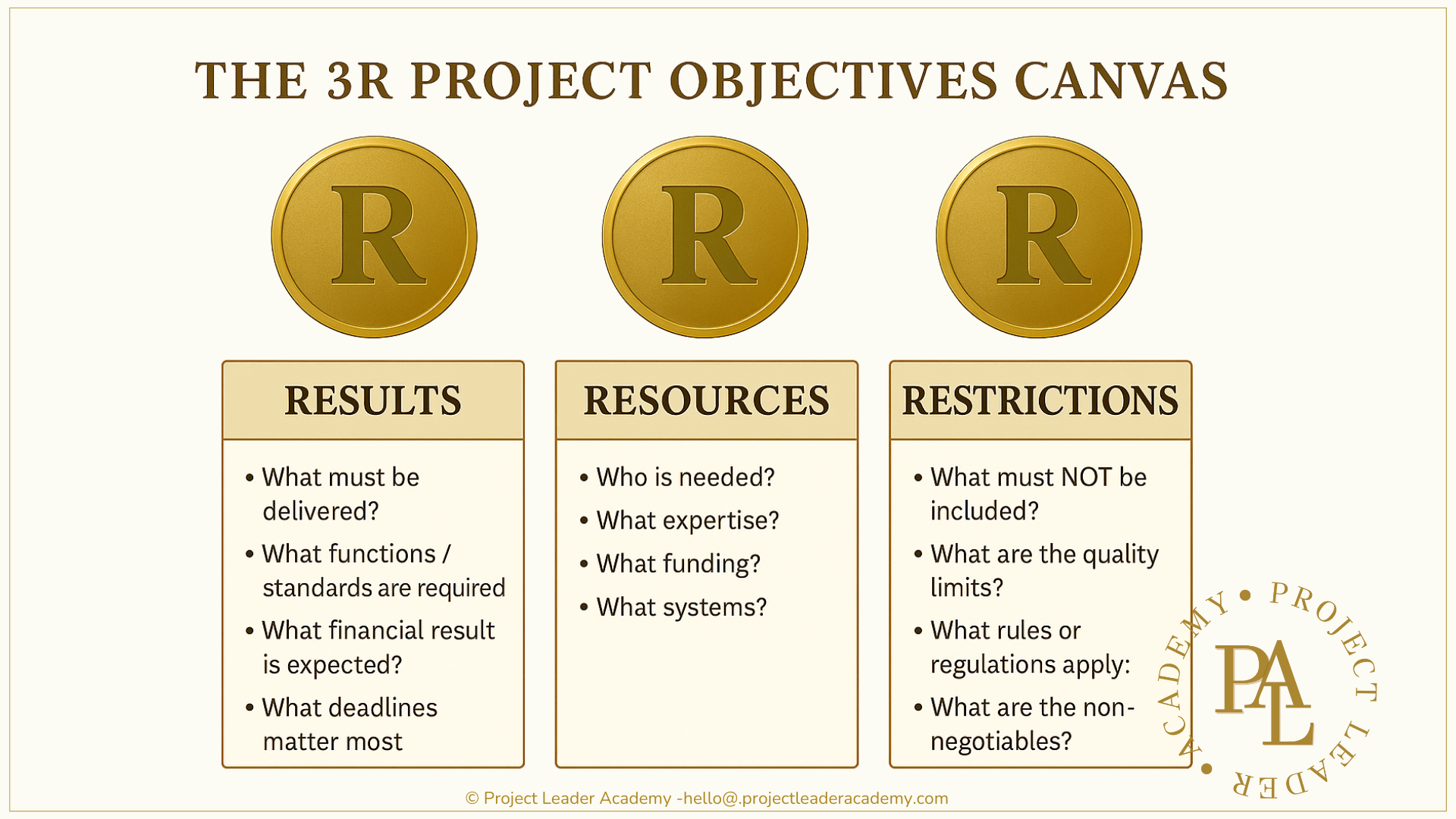 The 3R Project Objectives Canvas — a clear, elegant way to define what truly matters before planning begins.
The 3 Types of Results You Must Clarify
1. Quality Results (What the project must deliver)
These describe what the final product or solution should be like.
What does the solution must deliver or achieve, independent of resources.
- What functions should it have?
- How fast should it work?
- How good should the quality be?
- What should it look like? (color, size, shape)
- How strong or durable should it be?
- How reliable does it need to be?
Quality results define what “good” looks like.
If this part is vague, everyone imagines something different — and that leads to scope creep.;
2. Money Results (How the project affects cost or profit)
This is all about money going out or coming in. How the project is expected to create, protect, or save money.
Examples:
- How much money do we want to save?
- How much profit should the project create?
- How much can we spend?
- What is the budget limit?
- How much waste or cost do we want to reduce?
Money results make sure the project is profitable— or that the budget for the execution can be provided.
When this part is unclear, budgets explode and decisions for budget approvals get stalled and projects do not take off at all.
3. Time Results (When things must be finished)
This one focuses on deadlines, speed, and timing. What must be achieved within a certain timeframe or lifecycle.
Examples:
- When should the project be finished?
- How long can each part take?
- When do we need to launch?
- How fast should the system respond?
- How quickly should customers get the result?
Time results keep the project realistic and help to pushe them through the finish line.
When timing isn’t clear, people guess — and guessing leads to missed deadlines.
Time-driven results are equally important as functional and financial results — especially in competitive or fast-moving markets.
A delay is not a neutral event; it has financial and political impacts.
Did you know?
The more time you allow, the more time the project will take — unless you define it clearly.
Project Resources: What do You Need Before You Plan
There are 5 types of project resources
- EXPERTISE-PEOPLE
- MONEY-FINANCING
- MATERIALS −CONSUMABLE
- EQUIPMENT-MACHINES-SOFTWARE
- LICENSES-KNOW HOW
Project Restrictions: The Boundaries That Define Success
The 6 Types of project restrictions
1. COSTS- Is there really a limit? we need to stay under this budget of 100 Million
2. SCOPE -What is not in the scope?
What needs to be in the scope?
3. QUALITY - the building needs to be resistant to the 8.0 Richter earthquake.
4. Customer Satisfaction
Mrs. Miller has to like the solution, who else?
5. LEGAL employment law, safety requirements, government regulations, environmental & other requirements
6. METHODOLOGY
What software and processes and framework do we use?
The Siemens Example: The Four Project Goals We Used
The Four Types of Project Goals We Used In Siemens projects, we grouped project goals into three main categories — and I personally always added a fourth one, because it made stakeholder alignment dramatically easier.
1. Business Goal (Money Result)
- What result should the project create for the business?
-
Examples: profit of 30%, lower cost by 5%, revenue growth up to XXX, better ROI of XX
2. Process Goal (Workflow Result)
- How should the project work run better than before?
- Examples: fewer errors, faster decisions, better flow, fewer delays.
3. Behavioral Goal (Team Behavior Result)
- How should people behave to support project success?
- Examples: better communication, meeting deadlines, early warnings.
4. Personal Goal (Individual Stakeholder Result)
- What personal win matters to this person?
- Examples: learn a skill, gain visibility, reduce overload, build confidence.
Personal Goal are the hidden layer most people forget
This is the category you always added — and it’s the one that changes everything.
Personal goals describe what each stakeholder really wants on an individual level. Once you now them it helps a lot to lead them and manage their engagement.
You can also explore how a Personal Goal shapes behavior and engagement inside complex projects in this related guide.
What ‘Good Objectives’ Actually Look Like
Most project objectives sound fine on paper — until you try to use them to make a decision.
Phrases like “Improve efficiency” or “Deliver on time” look professional, but they’re too vague to guide real action.
A good objective is not just a statement. It’s a decision tool.
Strong objectives answer three simple questions:
- What exactly do we want to achieve?
- How will we know when we’ve achieved it?
- What trade-offs are we willing to make?
If your objectives can’t answer those, they’re not ready yet.
Good Objectives Are:
Specific
Everyone knows what “done” looks like.
Instead of “Improve reporting,” say “Automate monthly reports for all regions by Q3.”
Measurable
You can track progress with data, not opinions.
Reduce average response time by 25%” tells a story numbers can confirm.
Aligned
They connect directly to business and stakeholder goals.
If it doesn’t support the business case or the client’s success, it’s noise.
Balanced
They consider money, time, and results — not just one.
Speed at the cost of quality is not success.
Why take your time to set goals/ objectives?
Imagine you have signed off the project objectives, have planned all activities received the budget and started execution.
This was the case in a Hotel Project I was invited as a consultant in the middle of the project as the owner of the beautiful seaside property had hired an architect and construction company, they had built the shell of a complex of 400 rooms resort at the beach and couldn*+t get approval o the hotel management group for a management contract in order to get further financing of the project completion.
The reason was the rooms were not fitting into any norm of any 4 or 5-star hotel. management group.
The elevators were not meeting the new standards etc.
I provided him with an architect who cost him 50.000 USD to revise the plans and drawings and it took him some Millions to change the construction.
If he would have taken the time to analyze the stakeholder's requirements up front he would have saved time and money by getting hos project done faster. remember that all planning and execution is done in order to achieve the objectives. the objective is the destination and the activities are the sailes you set according to the wind to reach to your destination.
Who Sets the Project Objectives? (Coin Exercise)
Do you know the coin exercise?
In our seminars, we do exercises where executives, project managers, and engineers are requested to sort a bunch of coins. We put about 100 different coins and currencies on the floor and ask a team of 3 to sort them within 2 minutes. Triggered by the deadline they all start immediately without exemption sorting the coins in order to meet the deadline. Once they finished or got stopped by the watch I show my total disappointment and dissatisfaction in my role as being the Client. They all look surprised and I just ask the.m. Who sets the Project Objectives?
The Mentor Advice That Helped Me Start
My project plan
I was attending my first PM workshop and then I was appointed a leader and project manager of an international team creating a handbook and training concept for a procedure of Problem solving and Decision making.
I was asked to provide a project plan. So I was sitting in front of my computer and thought hm where do I start. I had attended the PM training and I was leading projects before but now I was sitting there, struggling to get started. Finally, I called my mentor. and he told me: to take it easy just start by writing down some objectives as assumptions and then verify your objectives with all relevant stakeholders.
Take time to interview all stakeholders about their vision, needs, and objectives. I strongly recommend doing the stakeholder analysis before you set objectives.
The Startup Perspective Trap
I f you are in the startup phase it is very likely that you see the objectives just from your angle and you ignore the market, the user, and the financing partners' goals.
It is hard to make clear assumptions on behalf of their interests. The support for your startup is mostly based on the emotions they have towards your project idea.
Sometimes a personal benefit is a key, sometimes it is the Ego that tells them how cool it would it be to be part of such an innovative endeavor.
Find it out.
! Know more about the people's motivation behind their support.
Have you ever had the situation that you did all of the above and confidently presented the results to your team and hope they will support you with expertise and high motivation and a positive attitude and you see the boring faces, feel the reluctance of taking on responsibility for the tasks you assumed they should do.
This is typically the situation when the sales manager sold a complex solution and the experts were not involved in the sale process and now at the moment of handover, they do not feel motivated at all.
Our clients were open to new ideas and ready to introduce change to the rule of who is involved in the sales process.
Spending time and recourses in that sales phase mad projects more profitable and we broke down the silos between departments like sales, service, and manufacturing and delivery.
Instead of 4 project managers, we empowered one responsible Project leader to lead through that process. the challenge is to sell and lead the communication between the client, all experts, financing partners, suppliers. and other stakeholders.
However, your leadership must be strong to keep motivation high. For innovative projects, it takes much more than money to make them successful.
Infrastructure projects require a set of political approvals for new regulations and often the business case that seems simple does not get understood by those people who have different concerns and focus.
To understand the hidden drivers behind a stakeholder’s support, this article breaks down how people’s motivation and a shared vision shape commitment.
Here our secret weapon is communication and relationship building, taking the time to understand the stakeholder's viewpoint in order to avoid blocking and set the foundation for at least a compromise. Strong Negotiation and Presentation skills are a must on that level.
How to set Smart Objectives?
In order to be smart, we need to know our stakeholder's and clients' objectives.
You may use interviews or workshops where you facilitate the process by writing the question on a flip-hart.
What are your objectives?
Once we have them collected we can use the SMART formula to make sure we have clarity and the same understanding of what we mean by this or that Objective.
S- Specific
M- Measurable
A- Actionable
R- Realistic
T- Timed
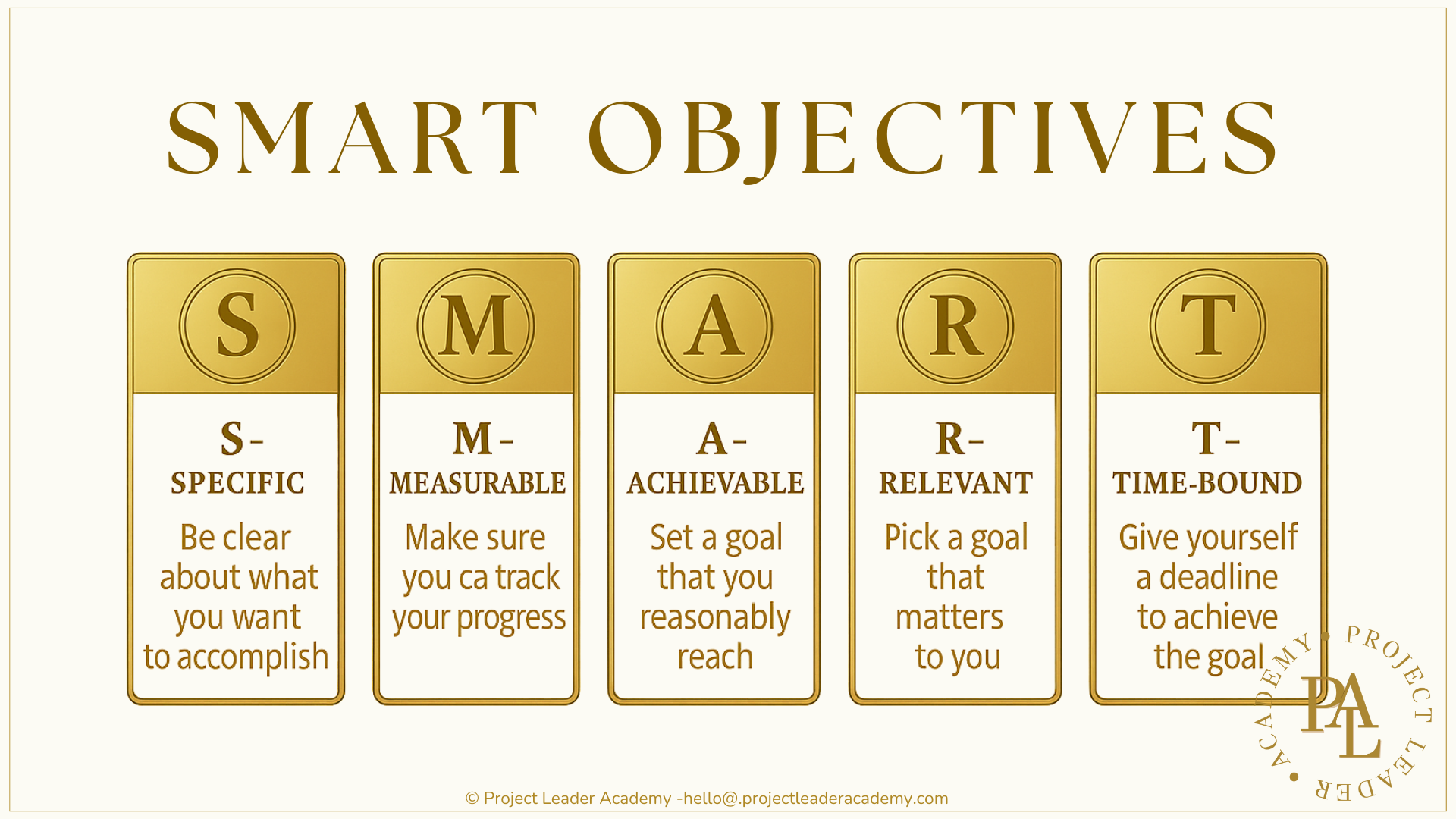
SMART Objectives – A Timeless Approach to Objective-Setting Excellence
If you use online meetings like Zoom or Teams you may use tools like Powerpoint slides or Google docs to visualize the objectives on the go. If you run a workshop I would use MIRO so that every one can participate and engage.
In my experience, people are so busy that when you just send them a list of ready objectives they might skip the thinking process and say yes to something they did not understand.
How to get a commitment to your project objectives?
The following 10 questions can help you to gain more insights and clarity about your stakeholder's goals:
- What do you want to achieve from this project?
- What goal do you want to achieve with this project?
- What would you like to happen by starting this project?
- What do you really want?
- What would you like to get accomplished?
- What result are you trying to get by this project?
- What outcome would be ideal?
- What do you want to change wit this project?
- Why are you hoping to achieve this goal?
- What would the benefits be if you achieved this goal?
Here is he Takeaway:
Whatever you do, make sure you get your project stakeholders aligned and gain real commitment to the project goals from the key decision-makers, users, and experts before you move into detailed planning, agile sprints, and execution.
If you want a simple structure for making clearer project decisions, you can explore the 5 Simple Steps to Making Great Decisions — it shows you how to analyse options and choose the right direction before planning begins.
If you want to see how stakeholder alignment works in practice, you can explore how to analyse and engage stakeholders — it shows you how to gain clarity before you define final project objectives.
Frequently Asked Questions about Project Objectives
How many project objectives should a project have?
In real projects, especially large technical ones, you can easily end up with twenty or more detailed objectives. I have seen this many times in complex corporate projects. The problem is usually not “too many ideas”, but that they are unstructured and nobody is clear on what really matters.
A practical rule of thumb is this:
- Define one overarching project objective – the “destination” that everyone can repeat in one sentence.
- Cluster the rest into a small number of objective groups (for example: quality or result, time, money, stakeholder impact, risk). Inside those groups you can have more detailed objectives, but they all roll up into a few clear pillars.
In my own projects we often had 20+ individual objectives, but they were always clustered and prioritised. Some were MUST objectives (non-negotiable), others were WANT objectives (nice to have if resources allow). That is the level of clarity you need.
If your objective list feels chaotic or endless, the problem is usually not the number of objectives – it is that they are not grouped, prioritised, and linked back to one clear destination.
What is the difference between a project objective, a requirement, and a technical specification?
These three are often mixed up, and that is one of the reasons projects drift. A simple way to separate them:
- Project objective = outcome we want.
It answers: “What result do we want to achieve, by when, with which constraints on time, money, and quality?” Objectives sit on the business and stakeholder level. - Requirement = what the solution must be able to do.
It answers: “What functions, features, performance levels or conditions must be fulfilled so that the objective can be reached?” Requirements translate the objective into concrete needs. - Technical specification = how exactly we will build or configure it.
It answers: “Which design, technology, standards, dimensions, materials or configurations will we use to implement the requirements?”
In short:
Objective = WHY and WHAT result
Requirements = WHAT it must do
Specification = HOW it will be realised
If you jump straight into technical specifications without clear objectives and requirements, you optimise the “how” while still being fuzzy on the “why” and the “what”. That is exactly where budget conflicts, scope creep, and endless rework usually start.
What can I do if the project has already started and we never defined clear objectives?
This situation is more common than most people admit. The good news: you do not have to cancel the project, but you do need to pause and reset.
A simple rescue approach:
- Call a short alignment session with the key decision-makers and experts.
- Ask three questions:
– What result must this project absolutely deliver to be seen as a success?
– What must be true about time and budget?
– What are we definitely not doing in this project? - Listen for contradictions – that is where your real clarification work starts.
- Write down 3–7 agreed objectives that reflect result, money, and time and share them with everyone involved.
- Use these objectives as your new filter for scope changes and priorities going forward.
You will not fix months of confusion in one meeting, but you can create a new baseline and stop the damage. From there, every decision, change request and planning activity should be checked against the clarified objectives.
Elevate Your Project with a CEO-Level Roadmap
Clarity is a strategic advantage — and this roadmap gives it to you in one elegant overview. It brings structure to your leadership, confidence to your decisions, and ease to your planning, so you move forward with intention rather than pressure. If you want a project that feels aligned, focused, and under control from the very beginning, this is the tool you download.
Click the image below to download your complimentary Project Planning Roadmap